
ZUGFeRD Explained: What Is It?
Anyone researching electronic invoices in Germany will often come across the term ZUGFeRD alongside XRechnung.
But what exactly is a ZUGFeRD invoice? How does the format work, and how is it different from a standard PDF invoice or XRechnung?
This article explains ZUGFeRD in simple terms.
What is ZUGFeRD?
ZUGFeRD is a standardized hybrid format for electronic invoices.
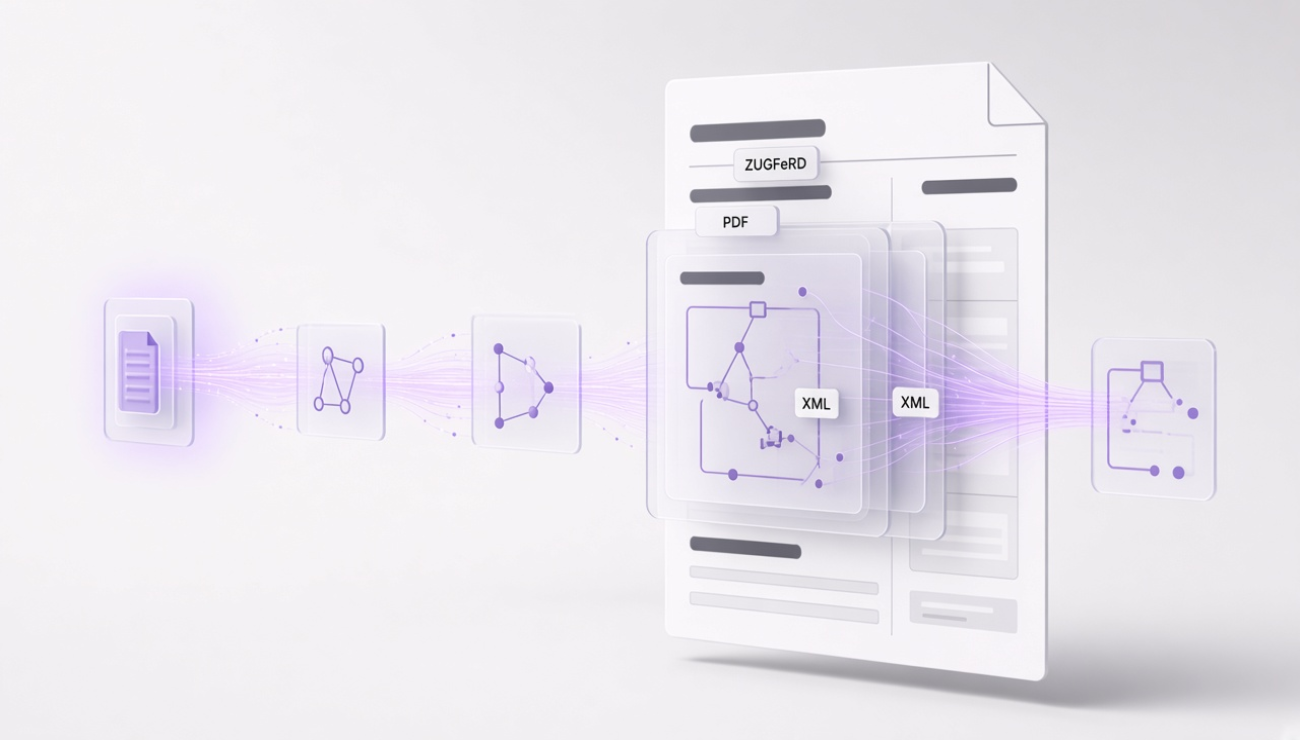
The key feature is that a ZUGFeRD invoice combines a human-readable PDF with structured XML invoice data in a single file.
The PDF provides the visual representation of the invoice, while the embedded XML data can be read and processed automatically by software.
In simple terms:
PDF: The invoice can be read by people.
XML: The invoice data can be processed by software.
How does a ZUGFeRD invoice work?
A ZUGFeRD invoice is based on a PDF/A-3 file.
Structured XML invoice data is embedded inside the PDF file.
The recipient can therefore view the invoice as a normal PDF while suitable accounting or business software can access the structured data contained in the same file.
ZUGFeRD vs. a normal PDF invoice
A standard PDF invoice mainly provides a visual representation of the invoice.
ZUGFeRD adds structured XML data to that representation.
In simple terms:
Standard PDF: Information for people.
ZUGFeRD: Information for people + structured data for software.
This combination makes ZUGFeRD useful for digital invoicing processes.
ZUGFeRD vs. XRechnung
XRechnung and ZUGFeRD are different electronic invoice formats.
An XRechnung consists of structured XML data and does not include an additional PDF representation.
A ZUGFeRD invoice, on the other hand, combines a PDF representation with embedded structured XML data.
Both formats can qualify as e-invoices when the applicable requirements are fulfilled.
Is ZUGFeRD an e-invoice?
Yes.
The German Federal Ministry of Finance recognizes ZUGFeRD from version 2.0.1 as an allowed hybrid e-invoice format, subject to the applicable requirements and profile limitations.
The format is based on the European EN 16931 standard.
ZUGFeRD can generally be used for B2B, B2G and B2C transactions.
What are the advantages of ZUGFeRD?
One of the main advantages of ZUGFeRD is the combination of human readability and structured data processing.
The recipient can view the PDF representation while accounting or ERP software can process the embedded XML data automatically.
This can help reduce manual data entry and simplify digital invoice workflows.
What is the current ZUGFeRD version?
The ZUGFeRD standard continues to evolve.
The latest version currently published by FeRD is ZUGFeRD 2.5.2, released on August 4, 2026.
When creating electronic invoices, it is therefore important to use software and a profile that match the intended use case.
Can you open ZUGFeRD as a PDF?
Yes.
This is one of the main differences between ZUGFeRD and a purely XML-based invoice such as XRechnung.
A ZUGFeRD file contains a PDF representation that can be viewed directly, while also containing structured XML invoice data.
However, for hybrid e-invoices, the structured invoice data is authoritative. If the XML data differs from the visual PDF representation, the structured data takes precedence.
How can you create a ZUGFeRD invoice?
A ZUGFeRD invoice can be created using suitable invoicing software.
The software generates the PDF representation and embeds the structured XML invoice data into the same file.
The completed e-invoice should then be validated according to the applicable technical requirements.
ZUGFeRD for freelancers and small businesses
ZUGFeRD can also be useful for freelancers, self-employed professionals and small businesses.
The format is particularly practical when an invoice needs to be readable by people while also being suitable for automatic processing by accounting or ERP systems.
When choosing invoicing software, it can therefore be useful to check whether ZUGFeRD is supported.
Create ZUGFeRD invoices with Zefare
With Zefare, freelancers, self-employed professionals and small businesses can create digital invoices and offers.
In addition to PDF invoices, Zefare supports ZUGFeRD and XRechnung.
This allows different electronic invoicing requirements to be handled through one digital solution.
Conclusion
ZUGFeRD is a hybrid electronic invoice format that combines a PDF with structured XML data in a single file.
This makes the invoice readable for people while also allowing software to process the structured invoice data automatically.
Anyone working with electronic invoices in Germany should therefore understand the differences between PDF, XRechnung and ZUGFeRD.